
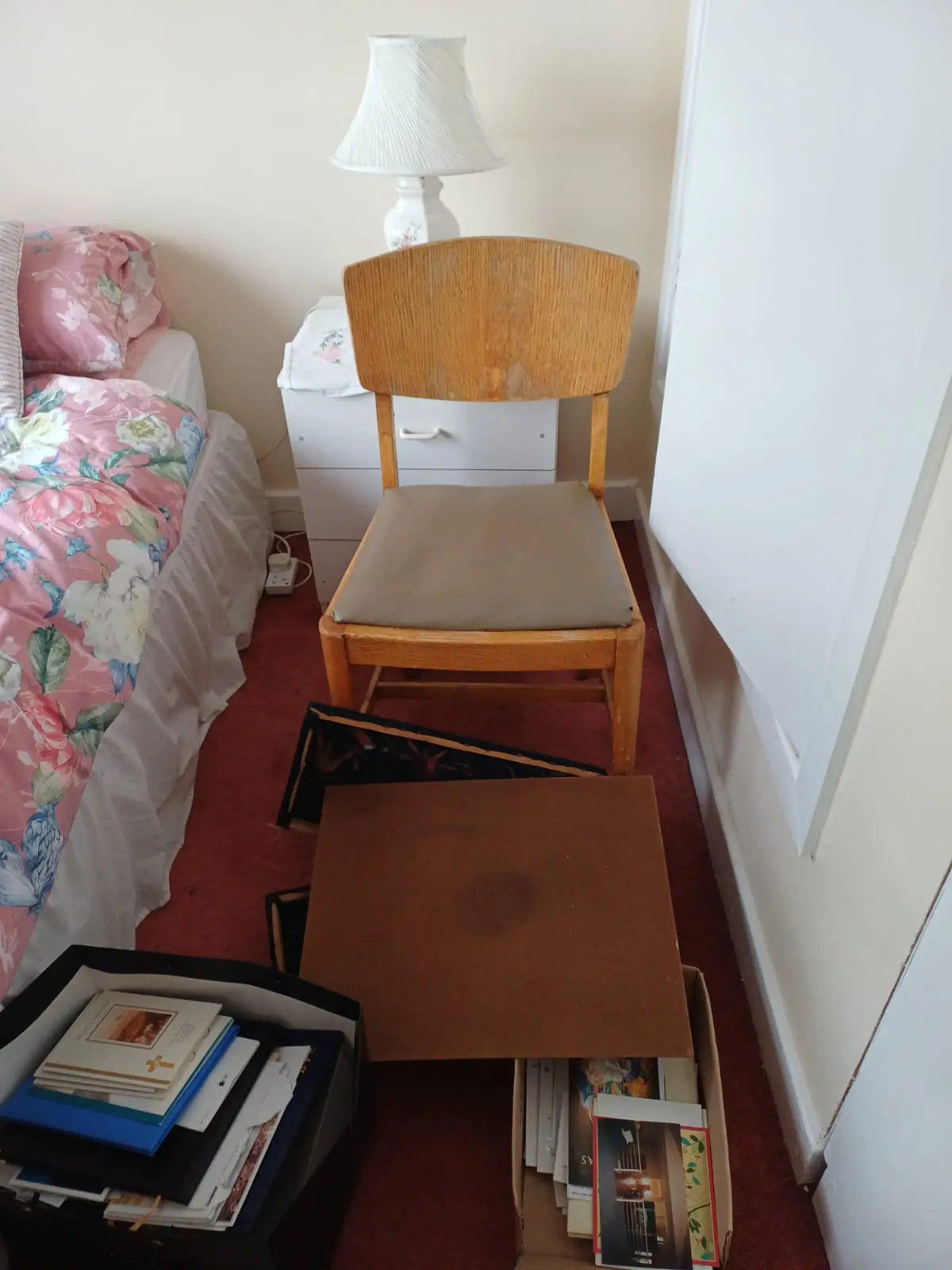
If you’re reading this, you are probably standing in — or dreading standing in — a house full of someone’s life. There is a will to deal with, a solicitor, perhaps an estate agent already asking when it will be empty, siblings with different ideas, and a lot of small objects that each carry a weight out of all proportion to their size. We can’t make that easy. What we can do is take the part that is physically and logistically hard off you, and be straight with you about how it works.
This guide is the long version. It covers the practical side (probate, executors, valuations, deadlines), the human side (what to keep, how to sort without being overwhelmed, how to manage a family that doesn’t agree), and the clearance itself. If you’d rather just talk to a person, the number is at the top of the page; and if you want the service detail — areas, pricing, the Dublin councils — it’s on the bereavement clearance Dublin service page.
What a bereavement clearance involves
In practical terms it is a house clearance (there is a separate guide to those): a crew comes with a truck, everything that isn’t being kept is loaded, sorted for reuse and recycling, and taken to authorised facilities, and the house is left swept and empty. What makes it different is everything around that.
The property is usually full in a way a normal house isn’t — forty or fifty years of one family’s things, with the papers, photographs and valuables mixed through the ordinary contents rather than gathered in one place. The people instructing the clearance are grieving, often busy with the estate, and sometimes not in Dublin at all. There is frequently a deadline being set by someone else: a probate valuer, a buyer, a landlord. And there is a real fear, which we hear in almost every first phone call, that something precious will go on the truck by mistake.
So a bereavement clearance is slower at the front end and more careful on the day. We expect sorting to happen during the job, not before it. We expect to be handed a list of things to look out for and a list of things to keep. We expect to find things — letters, cash, a ring in a coat pocket — and we stop and ring you when we do. And we expect that the family may want to be there for the start and not for the end, or the other way round, and we work around that.
Clearing a parent’s house
The most common situation, and the hardest. The house you grew up in, now being emptied. Our advice, from watching hundreds of families do it: gather the papers and photographs first, before anything else, in a single afternoon with a sibling; decide the few pieces of furniture that are genuinely going to someone’s home; and then let the rest be a job rather than a series of a thousand decisions. The things you’ll regret losing are the small personal ones, not the three-piece suite.
Clearing a relative’s or friend’s home
An aunt’s apartment in Rathmines, a brother’s house in Finglas, a neighbour you were executor for. The emotional weight may be lighter but the practical problem is often harder: you don’t know where things are, what matters, or what the person would have wanted kept. Here the sorting is more about papers and valuables than sentiment, and it helps to tell us that so the crew knows to check every drawer and box rather than assume the family has done it.
Probate, executors, solicitors and estate agents
You don’t need to understand probate to arrange a clearance, but a few points stop families getting caught out.
Can the house be cleared before probate is granted?
Usually, yes, for ordinary household contents — but ask the solicitor first. Where the contents have real value (antiques, art, collections) the estate may need a valuation of the contents before anything is disposed of, and a probate valuation of the property itself is often easier for the valuer if the house is cleared. If there is any dispute among beneficiaries about the contents, the executor should get agreement in writing before instructing a clearance. We’re not solicitors and this isn’t legal advice; it’s what we see going well and badly.
The executor’s role
The executor (or administrator, where there’s no will) instructs the clearance, pays for it from the estate, and keeps the paperwork. In practice the executor is often one of several siblings and the instruction comes with family politics attached. We work for whoever instructs us, we put the kept-items list in writing, and we send photos to anyone the executor names so that the sister in Australia sees the same thing the brother in Clontarf does.
Solicitors
Solicitors want an invoice from a permitted operator, a cleared property on an agreed date, and no surprises. We send our permit number (NWCPO-25-13287-01) and insurance details with the confirmation, and we can liaise with the solicitor’s office directly on access and dates if that’s easier for you.
Estate agents and valuers
Estate agents in Dublin want a cleared, broom-clean house for photographs and viewings; a cleared house also photographs larger and sells faster. If the agent is handling keys we can collect from and return to their office. For rental property being handed back to a landlord or letting agent after a death, the end-of-tenancy clearance page covers the extra bits — inventory, photographs, the deep clean.
What the family should sort before the clearance
This is the part people dread and the part that matters most. The rule is simple: gather the things that only the family can judge, and leave the rest to us. You do not need to bag, box, empty presses or carry anything. You need to find the papers, the photographs and the valuables, and decide on the handful of pieces that are going to someone’s home.
What to sort before the clearance
Sorting is the hard part. Do it in short sessions, with someone else, and don’t try to finish it in one day.
Papers — gather these first, even if you look at nothing else
Things that only matter to the family
Things to decide on, not necessarily keep
Things you can leave entirely to us
ManageWaste.ie · 083 090 4545 · managewaste.ie/guides/
Where things hide
From experience: cash and jewellery in coat pockets and handbags in the hall; important papers in the bureau, the bottom of the wardrobe and the drawer under the bed; photographs in shoe boxes in the attic; rings in the bathroom cabinet and the kitchen windowsill; medals and letters in the biscuit tin; and savings books inside other books. Our crew checks all of these on every bereavement job, and we ring you when something turns up — but it’s better if you’ve had the chance first.
Furniture
Decide the handful of pieces going to someone’s home and tag them. Everything else — beds, wardrobes, the three-piece suite, the kitchen table — is ours to sort, and older homes are full of solid furniture that can be reused; see furniture removal Dublin if furniture is the whole job.
Clothing
Clothes are the thing families find hardest and the thing with the most straightforward answer. Keep a bag of pieces that matter. The rest goes to textile reuse and recycling, which is a genuinely good destination; nobody needs to spend an afternoon folding a parent’s coats.
The attic, garage, shed and storage unit
Nobody wants to go up a ladder in the week after a funeral, and you don’t have to. Tell us what you think is up there and whether anything should be kept. We clear attics by handing everything down to the landing, where it can be checked. The same goes for garages and sheds, and for a self-storage unit if there is one — the storage unit clearance page explains how we handle the facility’s access rules and get the key back to you.
Families who live outside Dublin
A large share of the families we clear for aren’t in Dublin. They’re in Cork or Galway, or in London, Sydney or Toronto, with one trip home for the funeral and perhaps one more for the sale. The clearance has to work without them standing in the house, and it does.
Quoting from a distance
A neighbour, relative or the estate agent takes a dozen photos or a walk-through video on their phone and sends them on WhatsApp; or we call out, photograph every room ourselves, and send them to you with a fixed price. Everything after that is by phone, WhatsApp and email.
Keys and access
Keys come from a neighbour, a relative, the solicitor or the estate agent, or from a key safe you’ve had fitted. We return them the same way and confirm by text. If the alarm is set, we need the code and the monitoring company told.
Kept items
You send us a written list, with photos if you have them, of what is to be set aside — and where it should go. We can leave kept items in one room for collection, deliver them to another Dublin address, or box them for a courier. If you want to see something before deciding, we photograph it and wait for your answer.
Afterwards
Photos of every empty room, the invoice for the estate file, and a phone call if there is anything we need to tell you about. Several of the Google reviews further down this page are from families who never met us in person.
Arranging a bereavement clearance from a distance? Start here
Name, phone and one line about the job. We ring you back within the hour (8am–8pm) with a price, or ask for a couple of photos first.
Access, keys and working to a deadline
Most bereavement clearances in Dublin are working to someone else’s date. We’d rather know the date than guess it.
- Sale closing: we aim to clear a week before, so the final walk-through with the buyer is of an empty, swept house and there’s a margin for the things that always turn up.
- Probate valuation: ask the valuer whether they want to see the house as it is or cleared; most prefer cleared, some want to see contents.
- Rental handback: the landlord or agent will have an inventory and a date; we photograph before and after.
- Insurance: many policies have conditions on vacant properties — keep the heating ticking over in winter and the clearance is one more reason to get the house sold.
Access in Dublin is the same as for any house clearance — stairs, lifts, parking — and the house clearance guide covers it in detail. For an apartment, the management company will want our insurance on file and may need the lift booked; we handle that. For a terraced house in Crumlin, Cabra or Marino with no driveway, we look at the street from your photos and plan the truck accordingly.
What happens on clearance day
Families ask us this more than anything else, so here it is, step by step.
| What happens | What you need to do | |
|---|---|---|
| The day before | A text confirming the time and the crew lead’s name | Nothing — unless the kept list has changed; tell us |
| Arrival | Two or three of us in a box truck; we walk the house with you or with your list | Point out what stays, or leave us the list and the keys |
| The clearance | Top-down: bedrooms and attic first, then downstairs, then garage, shed and garden. Everything sorted on the truck. | Stay, go for a walk, or go home — your choice. We ring if we find anything personal we weren’t expecting |
| Finishing | Final walk-through, sweep, photos of every room if you’re not there, keys as agreed | Final check of the kept items before the truck leaves |
| Afterwards | Loads held briefly before sorting; invoice and permit details sent | Ring us straight away if something is missing |
Two things we’d add. First, you can be there for some of it and not all of it — many people stay for the walk-through, go for a coffee during the loading, and come back for the final check. Second, our crew has done this many times and has seen every kind of family reaction; nobody will think anything of it if you need to step outside.
Sorting during the day
We don’t insist that everything to be kept is removed before we arrive. If you want to go through the kitchen presses while we do the bedrooms, do. If a box of letters surfaces from the attic, we stop and you decide. Checking before every bag goes to the truck is normal on our jobs — it’s one of the things customers mention most in their reviews.
What happens to the belongings
People want to know that a parent’s things aren’t simply going into a hole in the ground. For the most part they aren’t.
Reuse
Furniture in good condition, working appliances, books, kitchenware, ornaments and household goods are set aside on the truck and go where they can be used again — reuse organisations, charity furniture projects, people who need them. Clothing goes to textile reuse and recycling. We don’t promise a specific destination for a specific chair, because it depends on condition and what’s wanted that week, but reuse is the first sort and a bereavement clearance typically has a higher reuse share than any other kind, because older homes tend to be full of solid, cared-for things.
Recycling
Electricals (WEEE) are separated and recycled — every Dublin council site also takes these free. Metal, cardboard, paper, clean timber and textiles go to the right streams; mattresses to mattress recycling; garden waste to composting.
Disposal
What remains goes to authorised waste facilities under our collection permit. Nothing is dumped and nothing goes to an unlicensed yard. If it would help to know, we can give you the facility details for the load.
Things we handle with particular care
Photographs, letters and documents found during the job are put aside, not disposed of, and handed to you — even when you’ve told us to clear everything. Religious items and medals likewise. If we find cash we tell you. If we find something we think you didn’t know existed, we ring. It is your family’s house, not a job lot.
Preparing the property for valuation and sale
Once the house is cleared, a few things make the sale or handback easier.
- Broom-clean as standard. We sweep through every room; a full clean for photographs and viewings is a separate job we can quote with the clearance.
- Carpets and curtains. Agents often advise leaving them for viewings; if they’re to go, tell us and we’ll lift them.
- Fixtures. Built-in wardrobes, kitchens and light fittings usually stay for a sale. We only remove what you’ve asked us to.
- Garden and outside. An overgrown garden and a full shed are the things buyers notice from the gate; we clear both on the same visit. See garden waste clearance.
- The paperwork. Our invoice, permit number and after-photos go in the estate file. Solicitors ask for them more often than you’d think.
The executor’s checklist
For the person who has to make it all happen.
Executor’s clearance checklist
Before instructing anyone
Instructing the clearance
After the clearance
ManageWaste.ie · 083 090 4545 · managewaste.ie/guides/
What happens next
Whichever of the situations above is yours, the process with us is the same four steps.
 Send photos. A photo of each room or area, through the quote form or on WhatsApp. For large or complex jobs we’ll offer to call out and look.
 Agree the job. You get a fixed price, a date and a written note of what’s being kept. No surprises on the day.
 The clearance. A crew of two or three with a box truck. We load, sort for reuse and recycling on the truck, and sweep through.
 Afterwards. Keys handed back as agreed, photos sent if you weren’t there, and loads held briefly in case something was missed.
What our customers say
Genuine reviews of our clearance crew on Google — 5.0 from 60 reviews on the House Clearance Spotless profile (Google Business Profile of our clearance crew (operated by Krystal Klean Express Limited)). Quoted as written; dates as shown on Google in October 2026.
★★★★★3 months agoCiprian and his team were so sympathetic and efficient when I contacted them to help clear out the apartment after a bereavement. The came and were very respectful in clearing completely everything, rubbish, books, clothes, kitchen, living room, bedroom in the apartment and left it spotless. The clearence took a lot of stress off me. I highly recommend them.
★★★★★5 months agoWe got Ciprian in to do a bereavement house clearance and I couldn't recommend him higher. They made what was really a difficult experience for us so much easier and Ciprian was a gentleman throughout and very understanding of what we were going through. Also it was very refreshing these days to see someone operating his business in a very transparent and honest way and the job they did was top class and left the house spotless afterwards.
★★★★★4 months agoCiprian and Brian and Willie were great. They cleared out our mom’s house after she passed away last year. Professional, organized, empathetic and resourceful. It was a job we were dreading but they did it quickly with no fuss. I’ve never made an effort to make a recommendation online but Ciprian exceeded expectations.
★★★★★5 months agoCiprian was a pleasure to work with and he and his crew worked exceptionally hard to clear my dad's house. I am very pleased with the service and the results. Two thumbs up and I would recommend them to anyone.
Bereavement clearance: questions families ask us
How does bereavement clearance work?
You send photos (or we call out), we give a fixed written price, you tell us what’s being kept, and on the day a crew of two or three clears the house top-down, sorting on the truck for reuse, recycling and disposal. We stop and ring you if we find anything personal, send photos of every room afterwards, and return keys as agreed.
Can an executor arrange the clearance?
Yes — the executor normally does, and the cost is an expense of the estate. We send our permit number and insurance with the confirmation and the invoice afterwards for the solicitor’s file. Where beneficiaries disagree about contents, we’d suggest getting agreement in writing before instructing us.
Can the house be cleared before probate is granted?
Usually yes for ordinary household contents, but check with the solicitor first; estates with valuable contents may need a valuation before anything is disposed of. This isn’t legal advice — it’s what we see in practice.
Do family members need to be present?
No. Many families hand over keys or a key-safe code and work with us by phone and WhatsApp, including from abroad. We send photographs of every room when we finish and can set kept items aside, deliver them within Dublin or box them for a courier.
Can sentimental items be separated?
Yes. Give us a list and tag or room-off anything to be kept. Our crew also puts aside photographs, letters, documents, jewellery and cash found during the job and hands them to you, even when you’ve asked us to clear everything.
Can the house be cleared in stages?
Yes. A common pattern is one visit for the furniture and outbuildings and a second after the family has had time with the personal items. Staged clearances are priced per visit; tell us when you ask for a quote.
How quickly can you clear a house after a bereavement?
Small jobs within a day or two of asking; full clearances within the week in most of Dublin. If a sale is closing or a valuation is booked, tell us the date and we’ll plan around it.
What happens to my parent’s belongings?
They are sorted on the truck: good furniture and household goods for reuse, electricals and recyclables to the right streams, and the remainder to authorised facilities under our waste collection permit. Nothing is dumped. Personal items found during the job come back to you.
Can you clear a rented flat after a death?
Yes. We work with the landlord or letting agent on dates and the inventory, photograph before and after, and can quote a deep clean with the clearance. The management company’s rules on lifts and loading bays are handled by us.
Are you a permitted and insured company?
Yes. ManageWaste.ie is operated by Krystal Klean Express Limited, holder of Waste Collection Permit No. NWCPO-25-13287-01, and is fully insured. The permit can be checked on the National Waste Collection Permit Office register.
Ready to get a price?
The bereavement clearance service this guide supports is here: Bereavement Clearance Dublin — what it includes, every area of the county we cover, what the four Dublin councils will and won’t take, and how it’s priced. Or skip straight to a quote.
Related guides
- House Clearance Dublin: the complete guideHouse clearance in Dublin explained by the crew: what it costs and why, photo quotes, full vs partial, apartments and access, what to keep, where it all goes.
- Hoarder Clearance Dublin: a discreet, step-by-step guideHow a hoarded or severely cluttered Dublin home is cleared — in stages, confidentially, without judgement: what to keep, sending photos, the day itself.
- Office Clearance Dublin: the complete guide for businessesOffice clearance in Dublin for relocations, closures and end of lease: desks, chairs, IT, archives, building management, city-centre access, quotes, checklist.