
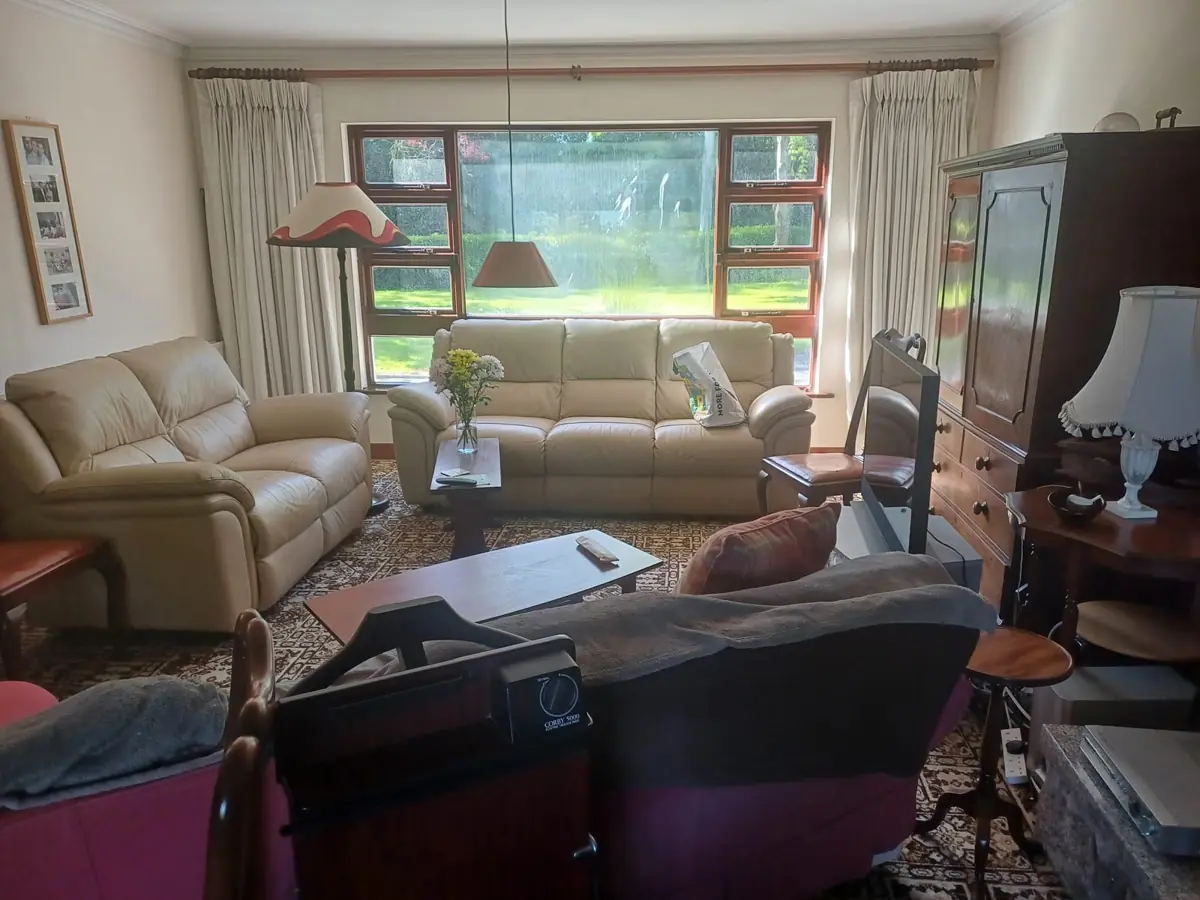
Most people arrange a house clearance once or twice in their lives, usually at a hard moment — a parent has died, a sale is closing, a tenant has left a mess, or a move abroad is three weeks away. You don’t know what it should cost, what the company will take, whether you need to be there, or what happens to forty years of belongings once they’re on a truck. This guide answers all of that for Dublin specifically, including the four councils and their very different rules, the realities of Dublin apartments and Georgian stairs, and what we’ve learned clearing homes from Skerries to Shankill.
It’s long on purpose. Use the contents list to jump to the bit you need, print the checklist, and when you’re ready the House Clearance Dublin service page has the pricing detail and every area we cover.
What a house clearance actually is
A house clearance is the removal of the contents of a property — furniture, appliances, the contents of presses and wardrobes, carpets if you want them gone, the attic, the garage, the shed and the garden — by a crew that loads it, sorts it and disposes of it under a waste collection permit. It is not a removals job (nothing is being delivered anywhere) and it is not a skip (nobody is asking you to carry a wardrobe down the stairs). You point, we lift.
The phrase covers a wide range of jobs, and the price and the approach change with the type, so it helps to be clear about which you need:
Full house clearance
Everything goes except what you’ve told us to keep. This is the probate clearance, the “we’re selling and it has to be empty by Friday” clearance, the end-of-tenancy clearance after a long let. In Dublin a full three-bed semi is typically a day for a crew of two or three with one box truck; a four-bed with a full attic, garage and shed can run to two days and two loads. We start at the top of the house and work down, because the attic and bedrooms are where the surprises are.
Partial house clearance
One or two rooms, or one category: all the furniture but none of the personal items, the attic only, the garage and shed only, everything in the back bedroom that’s been a storeroom since the kids left. Downsizers and decluttering jobs are usually partial clearances. They’re priced on what’s actually going, so a clear list or a set of photos matters more here than anywhere.
Single-room and bulky-item jobs
A sofa, a bed, a fridge and a wardrobe is not a house clearance; it’s a bulky-items collection, and it’s cheaper than people expect because it’s a van and two people for an hour. If that’s what you have, the junk removal and furniture removal pages are the better fit.
| Full clearance | Partial clearance | Bulky items only | |
|---|---|---|---|
| Typical situation | Sale, probate, end of tenancy, moving abroad | Downsizing, decluttering, one or two rooms, attic or garage | A sofa, a bed, a few appliances |
| What goes | Everything you haven’t tagged to keep, down to the contents of presses | The rooms or categories you choose | The items on the list |
| Time | Half a day to two days | Two hours to half a day | Under an hour |
| Crew | Two or three with a box truck | Two with a truck or van | Two with a van |
| Best page | House Clearance Dublin | Attic | Junk Removal Dublin |
The different kinds of clearance we do in Dublin
Every property type in Dublin has its own clearance problem. These are the ones we deal with every week, and each has its own page with the detail.
Apartment and flat clearances
Dublin has more apartments than any other county, and they are a different job from a house. In a purpose-built block — Sandyford, the Docklands, the schemes along the Luas lines, Santry, Adamstown — the issues are the management company (insurance on file, a booked lift, a time window for the loading bay) and the rule that nothing bulky goes in the bin store. In a converted period house in Rathmines, Drumcondra or Phibsborough the issue is three flights of narrow stairs and a street with no stopping. We price the two differently, and we explain how on the apartment clearance and flat clearance pages.
Attic clearances
Attics are the single most underestimated part of a house clearance. Twenty years of Christmas decorations, suitcases, the cot, the boxes from the last move, loose insulation and the odd bit of timber left by whoever did the floor. We bring our own ladder and lights, hand everything down through the hatch and sort it on the landing so you can check before it goes. Details on the attic clearance Dublin page.
Garage and shed clearances
Garages collect weight: tools, tins of paint, tiles from the bathroom that was done in 1998, the chest freezer, the lawnmower that doesn’t start. Sheds collect damp. Both are priced partly by weight, and both usually contain things we need to handle separately — paint, oil, gas cylinders, fuel — which we tell you about from the photos. See garage clearance and shed clearance.
Garden clearances
Overgrown gardens, decking coming up, a greenhouse of broken glass, fencing, the contents of the side passage. Green waste is cheap to dispose of; soil, stone and rubble are not. Covered on the garden waste clearance page.
Furniture and appliance removal
Sofas, beds, mattresses, wardrobes, dining sets, fridges, washing machines, cookers. Good furniture is set aside for reuse; white goods go for WEEE recycling, which every Dublin council site also takes free. If the job is only furniture and appliances, furniture removal Dublin is the page.
Storage units
A lot of Dublin house clearances have a second half sitting in a self-storage unit in Ballymount, Sandyford, Finglas or Swords — the things that were moved out “temporarily” years ago. We clear units in one visit so you can hand back the key and stop the rent: storage unit clearance.
The situations behind most Dublin house clearances
Why a house is being cleared changes how we approach it, how fast it needs to happen, and who we’re dealing with. These are the ones that come up most.
Moving house or moving abroad
The removals company takes what you’re bringing; we take what you’re not. The mistake people make is leaving the clearance to the last two days. Book the clearance for the day after the removals, not the same day, and give yourself a day of margin before the keys go.
Downsizing
Moving from a four-bed in Castleknock, Clontarf or Templeogue to a two-bed apartment means two-thirds of the contents aren’t coming. Downsizing clearances are almost always partial, almost always need sorting time, and are the jobs where reuse matters most to the customer — the good furniture that doesn’t fit should go somewhere useful, not into a skip. We can do these over two visits: one to clear what’s definitely going, one after the move for what’s left.
Preparing a house for sale
Estate agents want empty rooms for photographs and viewings, and buyers want vacant possession on closing. We clear to “broom clean” as standard — swept, nothing left in presses, the attic empty. If the property has been let, a pre-sale clearance often turns into an end-of-tenancy clearance with a deeper clean on top.
Landlord and end-of-tenancy clearances
A tenant has left, and either left everything or left a mess. Landlords in Dublin need the unit back on the market fast, a photographed record of its condition, and in apartment blocks a crew that won’t upset the management company. We photograph before and after as standard on these jobs. See end of tenancy clearance Dublin.
Probate and bereavement
Clearing a parent’s or relative’s home after they’ve died is the most common reason people ring us, and the one we take most care over. There is a whole separate guide to it — bereavement house clearance in Dublin for families and executors — covering probate, executors, solicitors, sorting sentimental items, and families who live outside Dublin. The service page is bereavement clearance Dublin.
Hoarding and severe clutter
A home where the clutter has made rooms unusable needs a different pace, a staged approach and real discretion. We’ve written that up separately too: the hoarder clearance guide, and the service page is hoarder clearance Dublin.
How the quote works — and why photos matter
We price almost every Dublin house clearance from photos, and we give a fixed price, not an estimate. Here’s why that works and how to get the most accurate number.
Why photos, not a visit
A clearance is priced on volume (how many truck loads), weight (what the facilities will charge us by the tonne), access (how long it takes to get it to the truck) and reuse (what we can keep out of disposal). All four are visible in a dozen phone photos. A visit tells us the same thing and costs you a day waiting in. For very large houses, hoarding situations or anything with a complicated access story we’ll still offer to call out — but it’s the exception.
What a good set of photos looks like
What photos to send for a quote
Phone photos are fine. Fifteen ordinary photos beat three careful ones.
One photo per room
The route out
Outside spaces
A note to go with the photos
ManageWaste.ie · 083 090 4545 · managewaste.ie/guides/
Video
If you’d rather, a 60-second walk-through video on WhatsApp works as well as photos — walk from the front door through every room, open the presses, finish at the attic hatch and the garage.
What you get back
A price in writing, usually the same day, with what’s included (loading, disposal, sweeping through, any dismantling we’ve discussed), what isn’t, a date, and a note of anything you’ve said is being kept. That note matters: it’s what the crew works from on the day.
How much does house clearance cost in Dublin?
We’re not going to give you a fixed price list here, because there isn’t one — the same three-bed semi can be a half-day job or a two-day job depending on what’s inside it. What we can do is show you exactly what moves the number, so you can read your own property.
| Factor | Pushes the price up | Brings it down |
|---|---|---|
| Volume | Full attic, garage and shed on top of the house; a lifetime of accumulation | Already-sorted rooms; bulky items only; one truck load |
| Access | Third-floor flat with no lift; long carry from the road; no parking on a Georgian street | Driveway at the door; ground floor; a loading bay we can book |
| Weight | Books, tiles, rubble, tools, garden stone — disposal is charged by the tonne | Furniture, clothes, soft furnishings — bulky but light |
| Reuse | Everything damaged, damp or broken | Good furniture and appliances we can set aside for reuse — it cuts the disposal bill and we pass that on |
| Timing | A fixed date at short notice, or out-of-hours work for a management company | “Any day this week” — we fit you into a round |
| Extras | Dismantling built-in wardrobes or kitchens; carpet lifting; a deep clean | A straightforward lift-and-load |
A few honest reference points from our Dublin work: a single room or a bulky-items-only collection usually starts in the low hundreds; a typical full three-bed house is a day’s work for a crew with one truck load; large houses with a full attic, garage and shed are two loads and priced accordingly. The disposal element is real money — Dublin facilities charge by weight, and a van of books or tiles costs more to tip than a van of sofas — which is why what can be reused genuinely lowers your bill.
Who pays for a house clearance?
Whoever instructs it. In a probate situation that’s normally the executor, and the cost is an expense of the estate — keep our invoice for the solicitor. In a tenancy it’s the landlord, who may recover it from the deposit where the tenancy agreement allows. In a sale it’s the vendor, unless the contract says otherwise.
Will a house clearance take everything?
Almost. We take furniture, appliances, carpets, the contents of presses, garden and shed contents, bagged general waste and the odds and ends that don’t fit a category. We don’t take asbestos, hazardous chemicals, full oil tanks, gas cylinders or fuel (we’ll advise who to ring), and large quantities of construction rubble are a separate conversation. The service page has the full list of what’s included and what isn’t.
What about the council?
If your job is small, the council route might be cheaper, and we’d rather you knew. Dublin City Council runs a bookable bulky-waste collection at €50 for up to five items, with a wait of up to ten days, for furniture and mattresses only. Fingal, South Dublin and Dún Laoghaire–Rathdown don’t collect bulky waste at all — you bring it to Coolmine or Estuary, Ballymount, or Ballyogan and pay per vehicle load. All four councils take fridges, washing machines and other electricals free. For a whole house none of this competes with a crew and a truck, but for three items it might. The service page sets out every council site, its charges and its rules.
Access: stairs, lifts, parking and Dublin’s particular problems
Access is the thing that most often makes two identical houses cost different amounts. It’s worth understanding because you can often improve it before we arrive.
Stairs
Every flight adds carrying time. A Georgian house in Dublin 2, 7 or 8 with belongings on four floors and a return on the stairs is a long day for the crew; a bungalow in Raheny with everything on one level is a short one. We protect stair carpets and banisters, and we price the floors honestly from your photos.
Lifts
In apartment blocks we book the lift with the management company and pad it where they require it. A block with no lift — common in the converted houses of Ranelagh, Rathgar and Drumcondra and in the older council flat complexes — is priced by floor. Tell us the floor when you send photos; it’s the first thing we look for.
Parking and loading
Our box truck needs to stop near the door. On a driveway in Lucan, Swords or Knocklyon that’s no problem. On a residents’-permit street in Portobello, Stoneybatter or Sandymount it means a long carry or a parking suspension, and on the quays or a city-centre street it can mean an early start before the clearway kicks in. Photograph the street outside and we’ll tell you what we need.
Loading bays and management companies
Most Dublin apartment managements will give us a 20-minute to 2-hour loading-bay window, want our insurance on file, and ban anything bulky from the bin store. We handle the paperwork — send us the agent’s details and we’ll sort it before the day. Early-morning and Saturday slots are available for buildings that restrict moves to certain hours.
Narrow lanes and long carries
Mews houses, cottages down a lane in Ringsend or Stoneybatter, and houses with a shared side passage all mean a carry from the road. It isn’t a problem; it just needs to be in the price, and it is if we’ve seen it.
What happens on clearance day
You get a text the day before confirming the time. On the day a crew of two or three arrives in a box truck — not a van that needs three trips — walks the property with you (or works from your written list if you’re not there), and confirms what’s staying before anything is touched.
We work top-down: attic, bedrooms, bathroom, then the ground floor, then garage, shed and garden. Everything is carried, not dragged; floors and stair carpets are covered on jobs where they need to be. Sorting happens on the truck as we load: furniture in good condition to one side for reuse, metal and WEEE separated, cardboard and paper separated, the remainder bagged or loaded loose for authorised disposal. You can watch, help, or go to work.
Before we leave, the crew does a final walk-through with you (or sends you photos of every room if you’re not there), sweeps through, and hands back keys as agreed. Loads are held for a short time before they’re tipped, so if you realise that evening that the box of photographs went, ring us.
How long does it take?
A bulky-items job is under an hour. A partial clearance — attic, garage, a couple of rooms — is two hours to a half day. A full three-bed is a day; a full four-bed with outbuildings is a day and a half to two days. If you have a hard deadline, say so when you book and we’ll plan the crew size around it.
Do I have to be there?
No. A large share of our Dublin customers hand over a key, give us a key-safe code, or have a neighbour or estate agent let us in. The written list of what’s being kept is what makes this work, and we send photos when we’re done.
Get a house clearance price for your Dublin property
Name, phone and one line about the job. We ring you back within the hour (8am–8pm) with a price, or ask for a couple of photos first.
What to keep, what to sort, and what to leave to us
The single biggest thing you can do before a clearance is decide what’s being kept and make it obvious. Everything else we’ll handle.
Collect these before anyone arrives
- Documents: passports, birth and marriage certs, deeds, insurance policies, bank and pension paperwork, wills, medical cards
- Photographs, letters, diaries and anything with a name on it
- Jewellery, watches, cash — check coat pockets, handbags, the backs of drawers, the hot press and under the mattress; it turns up in all of them
- Medication, which should go to a pharmacy rather than in general waste
- Keys, remotes, chargers and the manuals for anything staying with the property
Tag what stays
A sheet of paper taped to a wardrobe, a room with a sign on the door, or a list on WhatsApp. The crew checks the list before anything leaves, and on bigger jobs we check it twice.
What you don’t need to do
You don’t need to bag things, empty presses, dismantle furniture, carry anything downstairs, or take down curtains and blinds. Customers who do all of that have usually done a day’s work we were going to do anyway. Defrosting the fridge and freezer the day before is the one job that genuinely helps.
What happens to your belongings: reuse, recycling and disposal
This is the question people are most embarrassed to ask and most want answered: where does it all go?
Reuse
Furniture in good condition, working appliances, books, bric-a-brac and household goods are set aside on the truck. Where there’s a realistic second life — charity furniture projects, reuse organisations, people who need it — that’s where it goes. We don’t promise a specific destination for a specific item, because it depends on condition and demand that week, but reuse is the first sort, not an afterthought, and it lowers your disposal bill.
Recycling
Metal, cardboard and paper, clean timber, textiles, and all electricals (WEEE — fridges, washing machines, TVs, small appliances, cables) are separated and go to the right streams. Mattresses go to mattress recycling. Garden waste goes to composting.
Disposal
What’s left — damaged furniture, soft furnishings past use, general bagged waste — goes to authorised waste facilities under our collection permit. Nothing is dumped, nothing goes to an unlicensed yard, and you can have the facility details for your load if you want them. ManageWaste.ie is operated by Krystal Klean Express Limited, which holds Waste Collection Permit No. NWCPO-25-13287-01 — the number every Dublin council tells you to check before you let anyone take waste from your property. Waste that’s dumped illegally is traced back to the householder, which is the real reason the permit matters.
What we can’t take
Asbestos (old garage roofs, some floor tiles and textured ceilings — we’ll tell you what we suspect from the photos), chemicals, solvents, pesticides, full oil tanks, gas cylinders, fuel, fireworks, clinical waste. Paint in small quantities we can usually handle; tell us from the photos.
How to choose a house clearance company in Dublin
There are a lot of vans with “house clearance” on the side. These are the questions that separate a permitted, insured clearance crew from someone who’ll tip your stuff down a lane in Wicklow and leave you liable.
- What is your waste collection permit number, and can I check it? Every legitimate operator has an NWCPO permit number and will give it to you without hesitation. Ours is on every page of this site. It can be checked on the National Waste Collection Permit Office register.
- Are you insured, and for what? Public liability as a minimum. Apartment management companies will ask for the certificate; so should you.
- Is the price fixed or an estimate? A photo-based fixed price protects you. “We’ll see on the day” does not.
- What exactly is included? Loading, disposal, sweeping through, dismantling, carpet lifting — get it in writing.
- What happens to the furniture? You want to hear “sorted for reuse and recycling first, authorised facility for the rest,” and you want them to be able to say which facility.
- Can I keep things aside on the day? Some companies insist everything to be kept is removed before they arrive. We don’t; sorting on the day is normal for us.
- Who turns up? A crew and a box truck, or one person and a van needing four trips? It changes the day and the price.
- Can you show me reviews? Real ones, on Google, with names. Ours are further down this page.
Price matters, but the cheapest quote on a house clearance is often the one that doesn’t include disposal, or doesn’t include the attic, or isn’t a permitted operator. Compare like with like.
The house clearance checklist
Everything above, as a list you can print or save to your phone.
House clearance checklist
Two weeks before
The week before
On the day
Afterwards
ManageWaste.ie · 083 090 4545 · managewaste.ie/guides/
What happens next
Whichever of the situations above is yours, the process with us is the same four steps.
 Send photos. A photo of each room or area, through the quote form or on WhatsApp. For large or complex jobs we’ll offer to call out and look.
 Agree the job. You get a fixed price, a date and a written note of what’s being kept. No surprises on the day.
 The clearance. A crew of two or three with a box truck. We load, sort for reuse and recycling on the truck, and sweep through.
 Afterwards. Keys handed back as agreed, photos sent if you weren’t there, and loads held briefly in case something was missed.
What our customers say
Genuine reviews of our clearance crew on Google — 5.0 from 60 reviews on the House Clearance Spotless profile (Google Business Profile of our clearance crew (operated by Krystal Klean Express Limited)). Quoted as written; dates as shown on Google in October 2026.
★★★★★10 months agoI found Ciprians company on a Google search as I needed help with a very cluttered attic. I liked that the website said he would allow sorting and keeping on the day as I was as hoping to find items not seen for a long time. All other companies stressed that items to be kept needed to be removed before the visit. I have added a photo of the cover Ciprian put on the stair carpet. He also cleans carpets and wears all his hats on every …
★★★★★3 months agoI highly recommend Ciprian and his team. From my first contact to booking, everything was handled professionally and efficiently. They carried out a complete house clearance for us and did an excellent job. The team was friendly, reliable, and always available to answer any questions. They arrived on time, completed the work efficiently, and left the property spotless. I would happily recommend this company to anyone looking for a …
★★★★★5 months agoWould highly recommend Ciprian! Himself & his colleague did an excellent job on a house clearance recently. They were extremely thorough, professional & efficient. They arrived promptly & there was good communication with Ciprian who was easy to contact. A job well done.
★★★★★5 months agoWe got Ciprian in to do a bereavement house clearance and I couldn't recommend him higher. They made what was really a difficult experience for us so much easier and Ciprian was a gentleman throughout and very understanding of what we were going through. Also it was very refreshing these days to see someone operating his business in a very transparent and honest way and the job they did was top class and left the house spotless afterwards.
House clearance in Dublin: frequently asked questions
How much does house clearance cost in Dublin?
It depends on volume, access, weight and what can be reused — the table in the cost section above explains each. As rough reference points from our own Dublin jobs: a single room or bulky-items-only collection starts in the low hundreds; a full three-bed house is usually a day for a crew and one truck load; large houses with full attics and outbuildings are more. Send photos and you’ll have a fixed price the same day.
How long does a house clearance take?
Bulky items only: under an hour. Attic, garage or a couple of rooms: two hours to a half day. A full three-bed house: a day. A four-bed with attic, garage and shed: a day and a half to two days. Tell us your deadline and we’ll size the crew to it.
Do I need to be present for the clearance?
No. Many customers hand over a key or key-safe code, or an estate agent or neighbour lets us in. We work from your written list of what’s being kept and send photos of every room when we’re finished.
Can you clear an attic?
Yes — attics are part of most full clearances and a common job on their own. We bring ladders and lights, hand everything down through the hatch and sort it on the landing so you can check before it goes. See the attic clearance Dublin page.
Can you clear a garage or shed?
Yes. Garages and sheds are priced partly by weight (tools, tiles, paint and timber are heavy) and often contain items we handle separately — paint, oil, gas cylinders. Photograph the labels and we’ll tell you what we can take.
Can you clear an apartment?
Yes, and it’s a large part of our Dublin work. We deal with the management company — insurance on file, lift booking, loading-bay window — and never use the bin store for bulky items. Tell us the floor and whether there’s a lift when you send photos.
What happens to unwanted furniture?
It’s sorted on the truck. Good furniture goes for reuse where there’s a realistic second life; damaged furniture goes to an authorised waste facility under our permit. Reuse comes first because it’s right and because it lowers your disposal cost.
Can I send photos for a quote?
Yes — that’s how we price almost every job. One photo per room from the doorway, presses open, plus the stairs, the front door and the street outside. Send them through the quote form or on WhatsApp and you’ll have a fixed price the same day.
Will a house clearance take everything?
Everything except what you tell us to keep and the few things no permitted collector can take: asbestos, hazardous chemicals, full oil tanks, gas cylinders and fuel. We’ll tell you from the photos if we spot any of these and who to ring.
Who pays for a house clearance?
Whoever instructs it: the executor (as an expense of the estate) after a bereavement, the landlord at the end of a tenancy, the vendor before a sale. Keep our invoice — solicitors and letting agents routinely ask for it.
Do you clean as well as clear?
We sweep through and leave the property broom-clean as standard. A proper end-of-tenancy or pre-sale clean is a separate job that we can quote alongside the clearance.
Are you a permitted waste carrier?
Yes. ManageWaste.ie is operated by Krystal Klean Express Limited, holder of Waste Collection Permit No. NWCPO-25-13287-01, and is fully insured. You can check the permit on the National Waste Collection Permit Office register.
Ready to get a price?
The house clearance service this guide supports is here: House Clearance Dublin — what it includes, every area of the county we cover, what the four Dublin councils will and won’t take, and how it’s priced. Or skip straight to a quote.
Related guides
- Bereavement House Clearance Dublin: a guide for families and executorsClearing a parent’s or relative’s home in Dublin: what to sort first, probate and executors, families living away, what happens on the day, where things go.
- Hoarder Clearance Dublin: a discreet, step-by-step guideHow a hoarded or severely cluttered Dublin home is cleared — in stages, confidentially, without judgement: what to keep, sending photos, the day itself.
- Office Clearance Dublin: the complete guide for businessesOffice clearance in Dublin for relocations, closures and end of lease: desks, chairs, IT, archives, building management, city-centre access, quotes, checklist.