
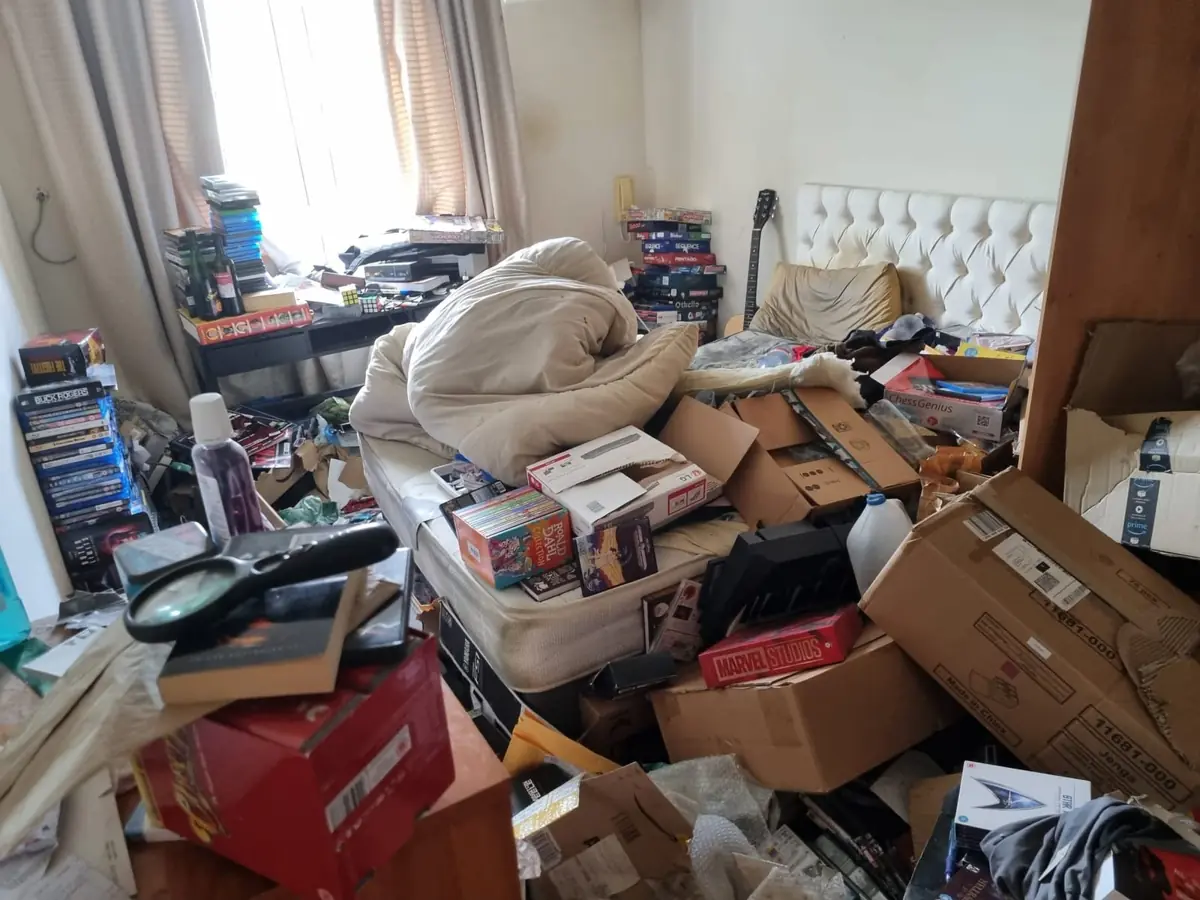
Most people who ring us about a hoarded house apologise in the first minute. There is no need. Severe clutter builds up for all sorts of reasons — grief, illness, a bad few years, simply time — and by the point someone is searching for help, the house has usually become a source of shame and stress for a long time. Our job is to clear it, and we do that without commentary, without photos ending up anywhere, and at whatever pace the people involved can manage.
This guide is for the occupant who is finally ready, for the son or daughter who has been asked to help, for the carer or support worker trying to make a home safe, and for the landlord or executor who has just opened a door and had to shut it again. It explains what the clearance involves, how a staged approach works, what we always look for and keep, how to send photos for a quote without anyone else seeing them, and what happens on the day. The service detail — pricing, every Dublin area, the councils — is on the hoarder clearance Dublin page.
What a hoarding-related clearance can involve
No two are the same, but most fall somewhere on a range. At one end is a house that is simply very full: every surface used, boxes along the hall, a spare room that can’t be entered, a garage packed to the door. At the other is a house where the clutter has become the floor, where rooms are reached by paths, where food packaging and post have built up over years, and where parts of the house have become unusable or unsafe. We clear both, and everything in between.
The rooms that matter most
Halls and stairs are where we start, always, because clearing the route makes everything else possible and makes the house safer within the first hour. Kitchens come next — spoiled food, packaging and the things that attract pests. Bathrooms likewise. Bedrooms are usually where the personal items are, so they are done more slowly. Living rooms tend to hold the paper: post, newspapers, magazines, in which the documents and money hide. Attics, garages, sheds and storage areas are often the oldest layer, and the heaviest — see the attic, garage and shed clearance pages for how we handle each, and storage unit clearance where part of the accumulation is in a rented unit.
Difficult-to-access rooms
If a room can’t be entered, we clear from the doorway inwards. If the door only opens a few inches, we clear what is behind it from that gap until it opens. If the stairs are blocked, the stairs are the job before the upstairs is. None of this is unusual to us.
Large volumes
A hoarded three-bed can hold three or four truck loads where a normal house holds one. We bring a bigger crew, we sort on the truck as we go, and we price per load so that the quote is honest about the scale of the job rather than a guess that gets revised on the day.
Who we work with: occupants, families, carers, landlords and executors
The person instructing a hoarder clearance is rarely the only person affected by it, and we take care about that.
The occupant
If the person who lives in the house is arranging the clearance themselves, they are in charge: what goes, what stays, how fast. We talk to them directly, not around them, and we are used to the decision being hard and sometimes changing. If they want to be present for every bag, that is fine. If they want to be out for the day and come back to a changed house, that is fine too.
Family members
Often a son, daughter or sibling makes the call on behalf of a parent who is still living in the house. We need to know whether the occupant has agreed and will be there, and we take our lead from the family on how to talk about it on the day. If the occupant is in hospital or care and the house is being made ready for their return, the general house clearance guide covers the practical side of making a home liveable again, and we can do a deep clean after the clearance.
Carers and support workers
Public health nurses, social workers, occupational therapists and housing-support staff ring us when a home has become unsafe for the person living in it. We can work to a care plan — the hall, the bed, the cooker and the bathroom first — and we can do it in stages so the person isn’t overwhelmed. We will give you a written quote and a written note of what was done, for the file.
Landlords
A tenancy has ended and the flat is full to the ceiling. We clear it, photograph it before and after, and can quote a deep clean so it can be re-let. The end-of-tenancy page covers the inventory and management-company side.
Executors
A relative has died and the house they lived in is in a state the family didn’t know about. This is more common than anyone says. We combine the care of a bereavement clearance — documents, photographs, valuables set aside — with the scale of a hoarder clearance. The bereavement guide covers probate, executors and families living away.
Discretion, confidentiality and no judgement
Three promises, because they are the three things people worry about.
Nobody will know unless you tell them. Our truck has our name on it and nothing else; it looks like any waste removal truck in any Dublin street. The crew doesn’t discuss the job with neighbours, and if someone asks, it’s a house clearance. We don’t photograph the inside of a property except for your quote and the before-and-after record you’ve asked for, and those photographs go to you and are not used anywhere.
Nobody will comment. Our crew has cleared many homes in this condition. They have seen worse than yours. They are there to carry things, not to react to them, and if you stand in the hall for the whole day you won’t hear a word said about the state of the house.
You are in charge. Of the pace, of what is kept, of who is present. If it is too much on the day and you want to stop after the hall and the kitchen, we stop, and we come back when you are ready.
The occupant of a hoarded home has often had years of comments from people who meant well. We are not going to add to them.
Can the property be cleared in stages?
Yes, and for an occupied home it is usually better. A single long day can be overwhelming for the person living there, and a house that has filled up over ten years doesn’t need to be emptied in one.
| Approach | When it suits | What it looks like |
|---|---|---|
| Single visit | Property is vacant, a landlord or executor is instructing, a deadline is fixed | A crew of three or four, one or two long days, sorted on the truck; found items boxed for you |
| Room by room | The occupant is living there and needs the house usable fast | Hall, stairs, kitchen and bathroom first — the rooms that make a house safe — then bedrooms, then storage rooms |
| Staged over weeks | The occupant is sorting with support, or the family can only be present at weekends | Two to four visits, each one agreed in advance; progress photographed; nothing touched between visits |
| Clearance plus follow-up | Preparing for a sale, a return home from hospital, or a housing-support inspection | Full clearance, then a deep clean and, if needed, a second visit for anything that surfaces |
Room-by-room clearance
The most common staged approach. We agree the order — almost always hall and stairs, then kitchen and bathroom, then the main bedroom — and clear one or two rooms per visit, fully, so that each visit leaves a usable room behind. The rooms not yet reached are left exactly as they are; nothing is moved between visits.
Multiple visits
Visits are priced individually, so you are not committing to the whole house on day one. Some families book two visits a fortnight apart; some occupants working with a support service book one a month. Both are fine. We photograph the cleared rooms at the end of each visit so progress is visible, which is often the thing that keeps a long job going.
What should be kept
In a hoarded house the valuable and the personal are mixed through everything else, and the fear of losing them is one of the main reasons the clearance hasn’t happened sooner. So this is how we handle it.
What should be kept — and what we look for
Always set aside, whatever we’ve been told
Kept if the occupant or family asks
Normally cleared
ManageWaste.ie · 083 090 4545 · managewaste.ie/guides/
How we sort on the day
Every bag and box is looked at before it goes to the truck — not tipped, looked at. Paper is the slow part: post, envelopes, bank statements, letters and photographs are all paper, and they are all in the same pile. We go through it. Found items — cash, jewellery, documents, photographs, anything with a name on it — go in a box that is handed to the decision-maker at the end of the day. If we find something we think matters and nobody mentioned, we stop and ask.
Collections
Books, records, models, newspapers kept for a reason, anything collected on purpose: tell us. A collection is cleared only if the person it belongs to says so, and if they want it kept we work around it.
Ready to talk about it? Name, phone, and one line is enough
Name, phone and one line about the job. We ring you back within the hour (8am–8pm) with a price, or ask for a couple of photos first.
How to send photos safely for a quote
We quote from photos because it means nobody has to let a stranger into the house before they’re ready. Here is how to do it without the photos going anywhere they shouldn’t.
- Send them on WhatsApp to our business number, or through the quote form. Both come straight to us. We don’t post, share or store them beyond your quote.
- Photograph from doorways. Stand in the door of each room and take one picture of what you see. Don’t climb over anything. If a door won’t open, photograph the gap and say so.
- Include the route out. The hall, the stairs, the front door, and the street outside so we know where the truck can stop. In an apartment: the corridor and the lift or stairwell.
- Tell us the main material. Paper and post, clothes, packaging, furniture — one line helps us size the crew and the sorting time.
- Tell us if anyone is living there, whether they know, and whether they will be present.
- Say what must be found. Passports, a will, a ring, the dog’s medication.
You will get back a fixed written price per visit, a suggested order for a staged job, and a date. If you would rather we call out and look instead, we will, and we will arrive in an unmarked car if you ask.
Access and practical safety
A hoarded home has risks a normal house doesn’t, and we plan for them rather than pretending they aren’t there.
- Blocked exits and stairs: cleared first, every time.
- Weight on floors: paper is heavy. Upstairs rooms packed with newspapers and books are cleared carefully and from the door inwards.
- Spoiled food, damp and pests: the crew wears gloves and masks where they’re needed, bags at the point of lifting, and seals bags before they go through the house.
- Sharps, broken glass, needles: if you know of any, tell us; if we find them, they go in a rigid container, not a bag.
- Electrics and gas: we don’t disconnect appliances that are live; tell us if the gas or electricity has been off.
- Hazardous materials: chemicals, solvents, gas cylinders, large quantities of paint and anything we suspect is asbestos are not taken on the truck. We tell you what we’ve found and who deals with it.
- Carrying: everything is carried by the crew; floors and stair carpets are covered where it matters; nothing is thrown from windows.
Access in Dublin — stairs, lifts, parking, management companies — is the same as for any clearance and the house clearance guide covers it. For a flat in a converted house in Rathmines or Phibsborough, or a council flat complex with no lift, we price the floors honestly and plan the loading so the stairwell isn’t blocked for the neighbours.
Furniture, appliances and the general waste
A hoarder clearance has the same categories as any clearance, in larger quantities.
Furniture is usually a mix: some solid pieces under the clutter that can go for reuse, and some that are broken or damaged by damp and go for disposal. We sort on the truck. Appliances — fridges, freezers, cookers, washing machines, microwaves, TVs, old computers — are separated for WEEE recycling whatever their condition. Paper and cardboard are recycled once the documents and photographs have been taken out of them. Textiles that are clean go to textile reuse; the rest is general waste. Food and packaging are bagged and disposed of. Garden, garage and shed contents are handled as on any job — green waste to composting, metal recycled, rubble and heavy material weighed and disposed of.
Everything that can’t be reused or recycled goes to authorised facilities under our waste collection permit (ManageWaste.ie is operated by Krystal Klean Express Limited, Waste Collection Permit No. NWCPO-25-13287-01). Nothing is dumped. Given the volumes involved in a hoarded house, that permit is worth asking any company for before you book — unlicensed dumping is traced back to the property it came from.
Preparing the home for occupation, or for sale
For the person moving back in, or staying
Once the clutter is gone the house usually needs a clean, and sometimes more: carpets that have been under paper for years, a cooker that hasn’t been used, a bathroom that couldn’t be reached. We can quote a deep clean with the clearance, and we can come back for a follow-up visit once the person has lived in the cleared house for a few weeks and knows what else they want gone. If a support service is involved we can time the follow-up with them.
For a sale or a re-let
Executors and landlords want the property empty, clean and photographable. We clear to broom-clean, lift carpets if asked, clear the garden and outbuildings on the same visit, and photograph every room afterwards for the file. If the house is going to be sold, the house clearance guide has a section on preparing for valuation and sale, and the house clearance Dublin service page covers the council sites if there is a last load the family wants to take themselves.
How to prepare for a hoarder clearance
The short version: you don’t need to prepare the house. You need to prepare the decisions.
How to prepare for a hoarder clearance
Before you ring anyone
Photos for the quote
The week before
On the day
ManageWaste.ie · 083 090 4545 · managewaste.ie/guides/
What happens next
Whichever of the situations above is yours, the process with us is the same four steps.
 Send photos. A photo of each room or area, through the quote form or on WhatsApp. For large or complex jobs we’ll offer to call out and look.
 Agree the job. You get a fixed price, a date and a written note of what’s being kept. No surprises on the day.
 The clearance. A crew of two or three with a box truck. We load, sort for reuse and recycling on the truck, and sweep through.
 Afterwards. Keys handed back as agreed, photos sent if you weren’t there, and loads held briefly in case something was missed.
What our customers say
Genuine reviews of our clearance crew on Google — 5.0 from 60 reviews on the House Clearance Spotless profile (Google Business Profile of our clearance crew (operated by Krystal Klean Express Limited)). Quoted as written; dates as shown on Google in October 2026.
★★★★★10 months agoI found Ciprians company on a Google search as I needed help with a very cluttered attic. I liked that the website said he would allow sorting and keeping on the day as I was as hoping to find items not seen for a long time. All other companies stressed that items to be kept needed to be removed before the visit. I have added a photo of the cover Ciprian put on the stair carpet. He also cleans carpets and wears all his hats on every …
★★★★★2 months agoAn excellent service! Ciprian arrived promptly and worked flat out with his team until the house was clear. It really was a job well done and a big relief for me. Thank you Ciprian.
★★★★★3 months agoCiprian and the team did a fantastic job clearing our full house plus our shed in a day and a half. They were very professional, clean and so quick. I highly recommend these guys.
★★★★★5 months agoCiprian was a pleasure to work with and he and his crew worked exceptionally hard to clear my dad's house. I am very pleased with the service and the results. Two thumbs up and I would recommend them to anyone.
Hoarder clearance: the questions people are afraid to ask
Is hoarder clearance confidential?
Yes. The truck carries only our name, the crew does not discuss the job with anyone, photographs you send are used only for your quote, and we don’t use before-and-after images anywhere unless you ask for them for your own records. If a neighbour asks, it’s a house clearance.
Can the property be cleared room by room?
Yes, and for an occupied home it’s usually the better approach. We agree the order — normally hall and stairs, then kitchen and bathroom, then bedrooms — and clear one or two rooms per visit, leaving the rest untouched between visits.
Do you judge the condition of the house?
No. Our crew has cleared many homes in this condition and is there to carry, sort and find what matters. You won’t hear a comment about the state of the property, and you don’t need to apologise for it.
Can a family member arrange it on someone’s behalf?
Yes — most hoarder clearances are arranged by a son, daughter, sibling, carer or support worker. We need to know whether the occupant has agreed and whether they will be present, and we take our lead from you on how to handle the day.
Can it be done over several visits?
Yes. Visits are priced individually, so you’re not committing to the whole house at once. Two visits a fortnight apart, or one a month alongside a support service, are both common. We photograph progress at the end of each visit.
What do you do with documents, money and jewellery you find?
They go in a found-items box that is handed to the decision-maker at the end of the day — every time, even if we’ve been told to clear everything. Paper is gone through, not tipped, because that is where the documents and cash are.
How much does a hoarder clearance cost?
More than a normal house clearance of the same size, because there is more material and far more sorting. We price per truck load and per visit from your photos, so the quote is honest about the scale rather than revised on the day. A hoarded three-bed is commonly three or four loads where an ordinary house is one.
Is it safe? What about pests, damp and sharps?
We plan for them: blocked exits and stairs are cleared first, bags are sealed at the point of lifting, the crew wears protective gear where needed, and sharps go in rigid containers. Hazardous materials — chemicals, gas cylinders, suspected asbestos — are not taken on the truck; we tell you what we’ve found and who deals with it.
Can you clean the house afterwards?
Yes. We quote a deep clean alongside the clearance when it’s wanted — carpets, kitchen, bathroom — and we can come back for a follow-up visit once the occupant has lived in the cleared house for a few weeks.
Are you permitted and insured?
Yes. ManageWaste.ie is operated by Krystal Klean Express Limited, holder of Waste Collection Permit No. NWCPO-25-13287-01, and is fully insured. Everything that can’t be reused or recycled goes to authorised facilities under that permit.
Ready to get a price?
The hoarder clearance service this guide supports is here: Hoarder Clearance Dublin — what it includes, every area of the county we cover, what the four Dublin councils will and won’t take, and how it’s priced. Or skip straight to a quote.
Related guides
- House Clearance Dublin: the complete guideHouse clearance in Dublin explained by the crew: what it costs and why, photo quotes, full vs partial, apartments and access, what to keep, where it all goes.
- Bereavement House Clearance Dublin: a guide for families and executorsClearing a parent’s or relative’s home in Dublin: what to sort first, probate and executors, families living away, what happens on the day, where things go.
- Office Clearance Dublin: the complete guide for businessesOffice clearance in Dublin for relocations, closures and end of lease: desks, chairs, IT, archives, building management, city-centre access, quotes, checklist.