
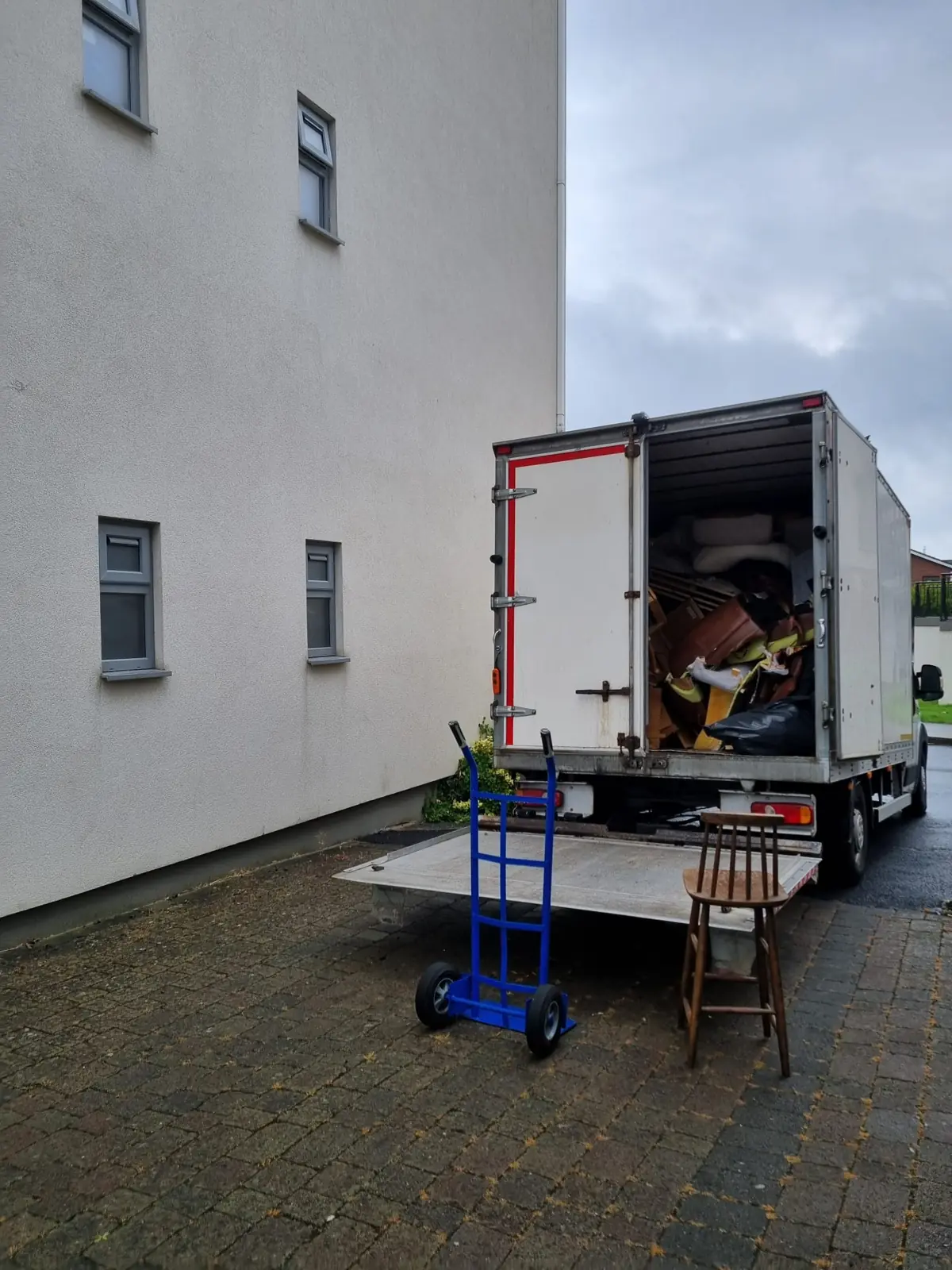
Why access decides the length of a clearance
People usually describe a clearance by what is in the house: a three-bed, a full attic, a garage. A crew thinks about it as a conveyor belt. Every item has to travel from where it sits to the truck, and the length of that journey, multiplied by the number of items, is most of the day. A sofa that has to go down one flight of stairs, along a short hall and out of a front door onto a drive is a two-minute job. The same sofa on a first floor, down a turning staircase, through a narrow side passage, down eleven steps and along a hundred metres of road to where the truck could stop is a very different job.
This matters for three reasons.
- It sets the price. We do not publish prices, because a quote follows the job. Access is one of the main things that moves it, alongside volume, weight, the mix of items, how much can be reused and your timing.
- It sets the number of people. A job with long carries can be done with a crew of two or three, but it will take longer, and some very heavy items need three people at every stage.
- It is something you can influence. Moving a car, arranging a space, asking a neighbour to share a drive, or booking a lift can save more time than any amount of tidying inside the house.
Howth is a good example of why it is worth thinking about. If the property is up steps, down a lane, on a road with restricted parking or at the end of a shared drive, say so plainly when you ask for a quote. If it is none of those, that is useful to know as well. The sections below tell you what to look for and what to send.
Assess your own property in ten minutes
Walk the route a sofa would take from the middle of the house to the road, and write down the answers. These are the questions a crew would ask you on the phone, so having them ready speeds up the quote.
- How many floors does the furniture have to come down? Include the attic and any basement or garden level.
- What are the stairs like? Straight or turning, wide or narrow, carpeted or bare, with a banister that gets in the way.
- How wide are the doors? A wardrobe or a double mattress that went in before the walls were finished may not come out the way you would expect.
- Is there a hall or porch with a tight turn? Photograph it from the front door.
- What is outside the front door? Steps, a path, a gate, a slope, a step down to the road.
- Where can the truck stand? On a drive, on the road, in a shared courtyard, in a car park, or not close at all.
- How far is that from the front door? Pace it out and note the number.
- Is there a second route? A side passage or back lane can be shorter, but only if it is clear and has no locked gate.
- What time can we arrive, and is there any restriction? Some roads, estates and apartment blocks have rules about access times or noise.
- Is anyone else affected? Neighbours who share a drive, a management company, a landlord.
Once you have those answers, add a photo of each. A single photo of the front door, one of the drive or road looking away from the house, and one of the stairs gives a crew more information than a paragraph of description.
What to photograph, and from where
Phone photos are fine. Fifteen ordinary photos beat three careful ones. For an access-heavy job, take these in addition to the usual room photos.
| Photo | Why it helps |
|---|---|
| The front of the house from the road | Shows steps, gates, slope and the distance to the door |
| The road or drive in both directions | Shows where a truck could stand, and whether there is parking pressure |
| The path or steps from the door to the kerb | The carry route, which is often the slowest part |
| The inside of the front door and hall | Tight turns, narrow doors, a radiator or banister in the way |
| Each staircase from the bottom and from the top | Width, turns, headroom, bare or carpeted |
| Any side passage, back gate or lane | An alternative route, and whether it is blocked |
| The attic hatch and landing | How things come down, and whether there is a fixed stair or a ladder |
| Large items from a wide angle | Wardrobes, sofas, a double bed |
Add a line of text saying what you cannot photograph: “the lift is out on Mondays”, “the neighbour’s car is usually parked across the drive”, “the back gate is padlocked and I have the key”.
Parking and where the truck stands
We arrive with a box truck. It needs a place to stop that is close enough to carry to, level enough to load safely, and legal. On the day the crew cannot solve a parking problem that was not mentioned in advance, so it is worth solving yourself.
- A drive or private space: the simplest. Make sure cars are moved the night before, not on the morning.
- On the road: check whether parking is restricted at the time, whether there are yellow lines, and whether a neighbour’s car is usually parked at the spot you have in mind. A space in front of the house can be held by a cone, a bin or a person, but check that is acceptable on your road.
- A shared drive or courtyard: speak to the neighbours in advance. Tell them the day and the approximate hours so that nobody is blocked in.
- A management-company block: ask about loading bays, lift booking and noise hours. Management companies often need notice.
- No close parking at all: say so. A job can be done with a longer carry, but the crew needs to plan for it, and the quote reflects it.
If the truck has to stand some distance away, the carry is longer and the job takes longer. Tell us the real situation when you ask for a quote, so that the price, the crew size and the schedule are right on the day.
Steps, slopes, gates and shared drives: situation by situation
| Situation | What it does to the job | What helps |
|---|---|---|
| Steps up or down to the front door | Every heavy item is a careful two- or three-person carry | Clear the steps of pots and ornaments; tell us how many steps; dry steps are safer, so mention if they are slippery |
| A long path or drive to the road | Each trip is slower, so the day is longer | Check the path is clear and the gate opens fully |
| A sloping drive or lane | Heavy items need more care and more hands | Say if the slope is steep; park the truck where it can be loaded safely |
| A narrow gate or side passage | Large furniture may not fit; some items must be dismantled | Measure the narrowest point; dismantle beds and shelving units in advance if you can |
| A shared drive | The truck may block or be blocked | Agree a time with neighbours; move cars the night before |
| Restricted road parking | The truck may have to stand further away or wait | Check restrictions; hold a space if that is allowed; tell us what you know |
| An apartment with a lift | The lift sets the pace | Book the lift and pad it if the management company requires it |
| An apartment without a lift | Every item goes down a stair | Tell us the floor; clear the stairwell of anything stored there |
| A hatch and ladder to the attic | Items come down one at a time | Photograph the hatch; tell us if the attic floor is boarded; do not climb in if it is not |
Large and awkward items: what to do before the day
Some items cost the most time because of their size and not their weight. Planning for them in advance helps.
- Wardrobes: many come apart. If you know how, take the doors off and empty the inside. If not, tell the crew; the job is part of what they do.
- Beds: bed frames usually dismantle in minutes, and slatted bases lift out. Mattresses are bulky; see mattress disposal Dublin for the single-item option.
- Sofas and corner units: measure the narrowest door and hall. A sofa that came in through a window or before a bathroom was added is a candidate for dismantling.
- Dining tables: legs often unscrew. Keep screws and bolts in a labelled bag if the table is staying with the family.
- Kitchen appliances: defrost the fridge and freezer a day in advance. Disconnect water and gas supplies before the day, using a qualified person if needed, and tell us which appliances are still connected.
- Heavy items such as a stone-topped table or a cast-iron range: tell us in advance, so the right number of people are on the truck.
- Pianos: we remove pianos. Tell us about stairs, steps and access when you ask for a quote so the crew is planned for it.
- Garden items: sheds, trampolines and hot tubs are separate services. See shed removal, trampoline removal and hot tub removal.
How the day is sequenced when access is awkward
On a straightforward job, the crew works top-down and room by room. When access is difficult, the sequence is planned a little differently.
- Walk the route first. The crew look at the route from the heaviest item to the truck, decide where to put protection on floors and stairs, and identify pinch points.
- Clear the route. Bins, pots, loose rugs and anything on the stairs are moved so nobody trips.
- Heavy items first. Heavy and awkward pieces go early, when the crew are fresh.
- A staging area. On long carries, a spot near the door where items are grouped lets one pair carry from inside to the door and another from the door to the truck.
- Sorting happens at the truck. The load is separated as it goes on, so nothing has to be handled twice.
- Finish with a sweep. The house is swept through and any marks on the route are checked with you.
We work Monday to Saturday, 8am to 5pm, and not on Sundays. A long-carry job can need a full day where a similar house with good access would take a morning, so give the quote a realistic day.
Neighbours, noise and good manners
A clearance is noisy for a few hours and it often blocks part of a road or drive. A little courtesy goes a long way:
- Tell the neighbours the day, the approximate hours and the vehicle that will be there.
- Ask whether anyone has early-morning or night-shift sleeping to think about.
- Do not block a neighbour’s drive without agreement.
- Ask whether anyone would like the chance to take something before it goes; a neighbour may want a bookcase or garden pots.
- Leave a phone number with a neighbour in case a vehicle needs to move.
If you are clearing a property you do not live in, a neighbour is also a useful local contact for keys and for letting the crew in. Our guide to managing a clearance from a distance covers that in more detail.
Weather and the carry
Wet weather affects a clearance in practical ways: wet steps are slippery, cardboard boxes weaken, soft furnishings get damp and floors get muddy. Items that go outside to the truck in the rain are handled differently from those on a dry day. Things you can do:
- Sweep and clear steps and paths the evening before.
- Put a mat inside the door and tell the crew where it is.
- Move anything you want to keep dry to the room furthest from the door.
- Do not rely on a forecast; plan on the basis that the day may be wet.
- Tell us if there is a particular risk, such as a loose paving stone or a steep, shaded path.
We cannot guarantee a date or a weather outcome. If conditions are unsafe on the day, the crew will tell you and agree what to do.
Where waste can go if you handle part of it yourself
Howth is in the Fingal County Council area. Here is what the council offers, as we last checked.
Fingal County Council does not offer a bulky waste collection. It tells householders to use an authorised collector with a National Waste Collection Permit Office (NWCPO) permit, or to bring items to one of its two recycling centres: Estuary, Seatown Road, Swords (beside Swords Business Park), and Coolmine, Porter’s Road, Coolmine Industrial Estate, Dublin 15 (beside Coolmine Fire Station). Both open Monday to Friday 8am to 8pm (last entry 7:30pm) and Saturday 8am to 6pm (last entry 5:30pm), closed Sundays and bank holidays, and either may close in severe weather. The phone number is 01 890 5000.
| Vehicle | General and bulky waste, including wood and metal | Green waste |
|---|---|---|
| Car boot | €12 | €6 |
| Full car, jeep or SUV | €30 | €10 |
| Car van, or car plus trailer | €50 | €35 |
| Intermediate or Transit van | €128 | €80 |
Recyclables and household WEEE are free, as are fluorescent tubes, batteries and cooking and engine oil. Mattresses, carpets, duvets and pillows are charged, and so are soil and stones. The centres take household waste only: household bin refuse and commercial waste are refused. Staff are not permitted to help lift items, there are no public toilets, and payment is by debit or credit card. Council fees, opening days and rules change. The figures here are as we last checked them, October 2026 (council data checked on 6 October 2026), so confirm with the council or the centre before you travel.
The Fingal centres list household hazardous waste such as paint, herbicides and cleaners among the things they accept, with a charge, and they take cooking and engine oil free. We do not accept any of those items in a clearance, so if there are any in the house they need their own trip to the council centre, before the clearance day. Gas cylinders are not in the list of materials Fingal’s centres say they accept, so ask the council (01 890 5000) before you drive anywhere with one.
For a few carloads of small items, the recycling centres are a sensible choice. For a house whose problem is access, the centres do not help, because the difficulty is getting things out of the house, not getting them to a centre.
How a sorted load works
The load is sorted on the truck as each room is emptied. Furniture and household goods in good condition are set aside for reuse where there is a realistic second life; we do not promise a destination for a particular item, because that depends on condition and demand that week. Metal and electricals (fridges, washing machines, TVs, cables) are kept apart as WEEE. Cardboard, paper, clean timber and textiles are separated. What is left goes to authorised waste facilities under our collection permit, No. NWCPO-25-13287-01. Disposal is charged by weight, so every kilo kept out of the general load lowers the cost of the job.
What we do not accept. We do not accept paint, solvents, oils, fuel, chemicals or gas cylinders, in any quantity, and we do not accept asbestos or clinical waste. That includes the half-used tins in the shed and the bottle by the back door. We cannot make an exception on the day, so please set these aside, tell us about them when you ask for a quote, and use the council route described below.
The week before: an access checklist
- Walk the route with a tape measure and write down the narrowest point.
- Send the access photos and a note about parking and steps with your quote request.
- Agree the parking plan: space, cones, neighbours, management company.
- Move cars and bins the evening before.
- Clear stairs, landings, halls and paths of anything loose.
- Dismantle what you can: beds, shelving, curtain poles you want to keep.
- Tag or move what is staying to one room, away from the route.
- Set aside paint, solvents, oils, fuel, chemicals and gas cylinders for the council route, because we do not accept them.
- Defrost the fridge and freezer a day ahead.
- Tell the neighbours.
Questions to ask any clearance company about access
- Will you come and look at the access, or can you work from photos?
- How many people will be on the truck, and does that change if the carry is long?
- Does the price assume the truck can stand near the door?
- What happens if the truck cannot stand where we planned?
- Do you protect floors and stairs?
- What do you do if an item will not fit through a door?
- What is your waste collection permit number? (Ours: NWCPO-25-13287-01.)
- What will you not take? (Ours: paint, solvents, oils, fuel, chemicals, gas cylinders, asbestos and clinical waste.)
Howth clearance and access questions
Does a clearance cost more if the access is difficult?
The price follows the job. Steps, long carries and distant parking add time, so they are part of what we ask about. We do not publish prices; send photos and the access details for a fixed quote.
Can you work if the truck cannot park outside?
Often yes, with a longer carry and a different plan. Tell us the real situation at the quote stage rather than on the day.
Who collects bulky waste in Howth?
Fingal County Council does not offer a bulky waste collection. It tells householders to use an authorised collector with an NWCPO permit or to take items to the Coolmine or Estuary recycling centres.
Do you take paint, solvents, oils, fuel, chemicals or gas cylinders?
No, in any quantity. Fingal’s centres accept some household hazardous waste with a charge, and cooking and engine oil free; ask the council about gas cylinders.
Which days do you work?
Monday to Saturday, 8am to 5pm. We do not work on Sundays.
Do you remove pianos?
Yes. Tell us about stairs, steps and access when you ask for a quote.
Do you shred papers or destroy data?
No. We do not offer shredding or data destruction, so sort and remove documents and devices yourself first.
What our customers say
Genuine reviews of our clearance crew on Google, quoted as written; dates as shown on Google in October 2026.
★★★★★2 months agoAn excellent service! Ciprian arrived promptly and worked flat out with his team until the house was clear. It really was a job well done and a big relief for me. Thank you Ciprian.
Ready to get a price?
The service this guide supports is House clearance Dublin, with the areas we cover and the local council facts. Or skip straight to a quote.
Related pages
- House clearance Dublin
- Furniture removal Dublin
- Attic clearance Dublin
- Garage clearance Dublin
- House clearance in Balbriggan when you live elsewhereManaging a Balbriggan house clearance from another county or country: keys, photo protocol, video walk-throughs, authority to instruct, security, and the Fingal council facts.