
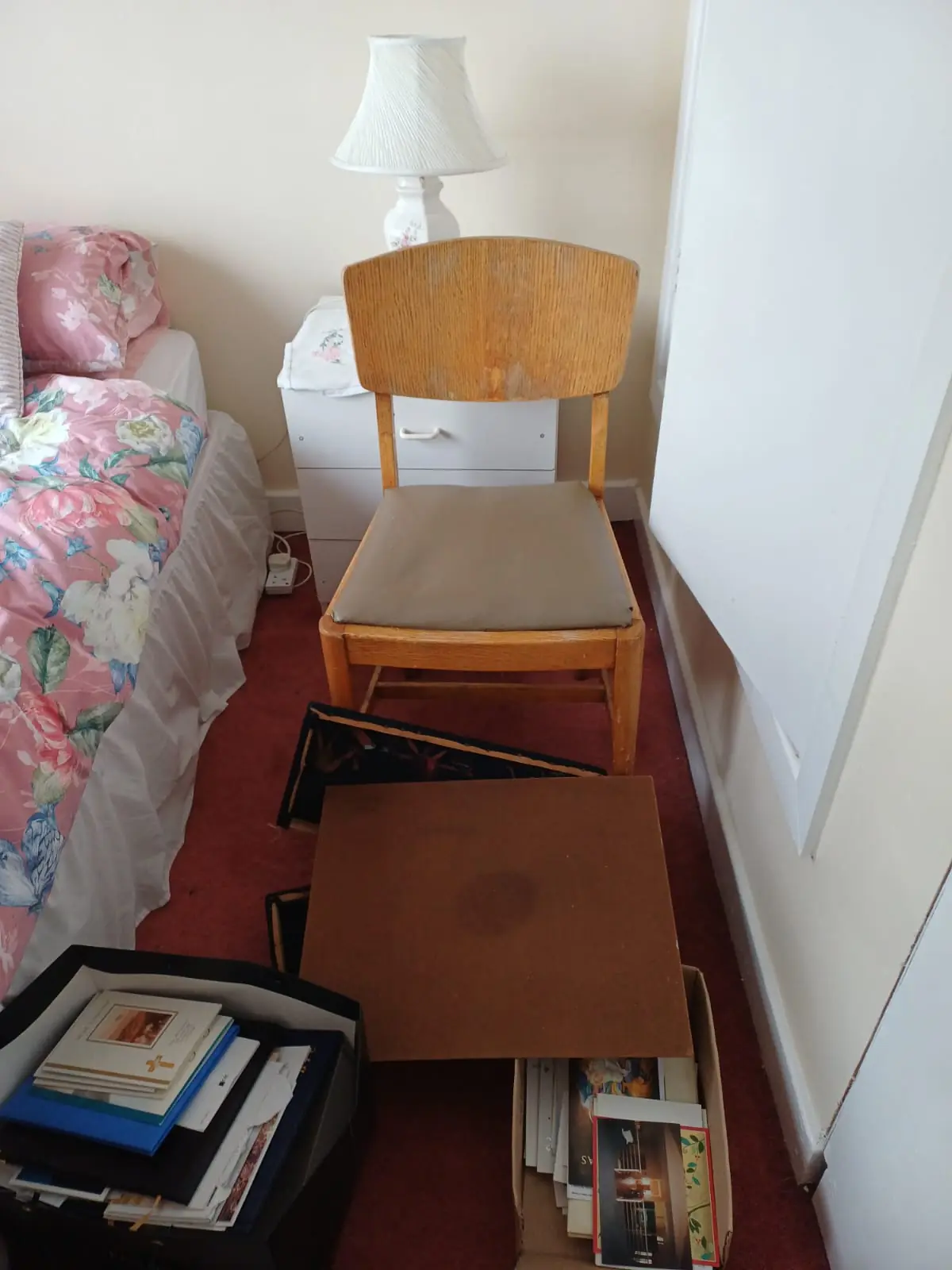
What being the executor of a house clearance means in practice
The executor, or the administrator where there is no will, is the person who instructs the clearance, who the crew take instruction from on the day, and who usually pays from the estate and keeps the paperwork. It sounds administrative, and it is, but it is also being the person who has to ask a sister whether she wants the wardrobe.
We are not solicitors and none of this is legal advice. Your solicitor leads on probate and on what the estate needs. What we can describe is the practical side of the house, because we see how it goes well and badly.
A useful way to hold the job is as a small project with five parts.
- Secure and understand the house. Keys, insurance, utilities, what is there.
- Find and protect what matters. Papers, valuables, photographs, anything with sentimental or financial weight.
- Agree who gets what. The family’s claims, in writing, with a deadline.
- Clear the rest. A permitted crew, a fixed price, a date.
- Close out. Invoice for the estate, cleaned and empty house, utilities and post, handover to the solicitor or estate agent.
The sections below take each part in turn.
Part 1: secure the house and understand what you have
Keys and access
Count the keys. Find out who has a set: family, neighbours, a cleaner, a carer, a key safe code. Decide who is allowed in, and tell them. Change codes if you need to.
Insurance
Check the home insurance policy. A property that is vacant, or that becomes vacant, often has conditions about heating, regular visits and contents. Your solicitor or the insurer can tell you what applies to your policy.
Utilities and perishables
Keep the electricity on for the clearance, so that the crew can see and the fridge can be defrosted. Empty the fridge and freezer of food. Turn off the water if the house will be empty for a while. Redirect post and make a note of account numbers on bills; you will need them to close accounts.
Walk the house once, with a notebook
Go through every room, the attic, the garage and the shed. Do not decide anything. Write down what kind of house it is: how full, how many rooms, what is in the attic, whether there are outbuildings. Take photos. This single walk-through is what you will use to talk to the solicitor, the family and a clearance company.
Safety
If you see signs of damp, damage, pests, loose floorboards or suspect asbestos in old sheeting or insulation, note it and tell the crew in advance. We do not accept asbestos.
Part 2: find and protect what matters
This is the part that cannot be handed to a crew, and it is worth doing before any contractor visits. It does not have to be done in one day; it is best done in short sessions with another person.
Papers
Gather into one box or folder: the will and any letter of wishes; deeds, mortgage and title documents; bank, credit union, pension, insurance and investment paperwork; certificates, passports and licences; recent bills and post; medical card and prescriptions. Look in drawers, bureau tops, handbags, coat pockets, books and tins.
Cash, jewellery and small valuables
Check jewellery boxes, handbags, coat pockets, the pockets of clothes in the wardrobe, the hot press, the freezer, behind pictures and in books. Items turn up in unlikely places. Keep a list of what you find and where, with photographs.
Photographs and personal papers
Albums, loose photographs, letters, cards, diaries, address books. Put them together in boxes and label them. Do not read them under time pressure.
Devices
Phones, tablets, computers and external drives may contain photographs, accounts and documents. Keep them together. We do not offer shredding or data destruction, so decisions about wiping or disposing of devices and about documents with personal information are yours and the solicitor’s.
Valuables that might be worth a professional view
Antique furniture, silver, paintings, clocks, coin or stamp collections. We do not value or sell contents. Photograph anything that might be worth asking about, including makers’ marks and signatures, and ask the solicitor whether the estate wants a valuation before the house is cleared. Keep anything in doubt out of the clearance and tell us it is staying.
Medicines
Unused medicines go back to a pharmacy.
Part 3: agree who gets what, in writing
The most common cause of conflict is not the objects but the process. Siblings who have not spoken for a year find themselves arguing about a clock. A little structure helps.
- Circulate photographs of rooms and of the main items. Anyone who cannot be there can see the same thing.
- Ask each person to list up to five things they would like, and why if they want to say. Compare the lists before anything is decided.
- Where two people want the same thing, ask the executor or a neutral relative to decide, or draw lots. Agree the method first.
- Set a deadline. “Anything not claimed by the 20th goes in the clearance.”
- Tag the items with a sticky label and a name, or move them to one room.
- Confirm it in writing by message or email, so there is a record.
- Arrange collection or delivery of the claimed items before the clearance day.
If there is a real dispute about the contents, pause. A truck cannot undo a loaded wardrobe. The solicitor can advise on how to proceed.
Estate agents, buyers, landlords and deadlines
The deadline for the clearance usually comes from outside the family. Ask the people concerned, early, what they need.
| Who | What to ask |
|---|---|
| The solicitor | Can the contents be cleared yet? Is a valuation of contents or of the house wanted first? |
| The estate agent | Do they want the house empty, partly furnished or broom-clean? When do viewings start? |
| A buyer, through the solicitor | What is staying with the sale? What condition is the property to be in at closing? |
| A landlord, if the person rented | What must be removed, by when, and what is the landlord’s own? |
| The insurer | Are there conditions on a vacant property? |
| The management company, if an apartment | Lift booking, loading times and common-area rules |
Give the clearance company the real date. It is better to tell us a hard deadline than to hope.
Part 4: the clearance itself
Once the personal items are out and the claimed items are tagged, the rest is a job of lifting, sorting and disposal. A crew of two or three arrives with a box truck. We walk the house with you or with your written list, then work top-down: attic and bedrooms, then downstairs, then garage, shed and garden. We work Monday to Saturday, 8am to 5pm, and not on Sundays.
You can stay, go for a walk or be somewhere else. If we find something personal that was not expected, such as cash, letters or jewellery, we stop and ring you. If you cannot be there, we send photos of every room, and keys go back as agreed. Loads are held briefly in case something was missed, so if you realise something is gone, ring us at once.
What the executor should hand over beforehand
- The kept list, in writing, with the name of who is confirming it.
- The keys, the alarm code and where the meter and stopcock are.
- The names of anyone else who may be present.
- The contact details for the solicitor or estate agent if they need to be told when it is done.
- Anything the crew should know about the property: a loose stair, a sensitive neighbour, a pet next door.
Where the contents go afterwards
The load is sorted on the truck as each room is emptied. Furniture and household goods in good condition are set aside for reuse where there is a realistic second life; we do not promise a destination for a particular item, because that depends on condition and demand that week. Metal and electricals (fridges, washing machines, TVs, cables) are kept apart as WEEE. Cardboard, paper, clean timber and textiles are separated. What is left goes to authorised waste facilities under our collection permit, No. NWCPO-25-13287-01. Disposal is charged by weight, so every kilo kept out of the general load lowers the cost of the job.
What we do not accept. We do not accept paint, solvents, oils, fuel, chemicals or gas cylinders, in any quantity, and we do not accept asbestos or clinical waste. That includes the half-used tins in the shed and the bottle by the back door. We cannot make an exception on the day, so please set these aside, tell us about them when you ask for a quote, and use the council route described below.
What Fingal County Council offers, for the part you handle yourself
Castleknock is in the Fingal County Council area. Many executors do some of the work through the council, such as taking a few carloads of cardboard and electricals themselves.
Fingal County Council does not offer a bulky waste collection. It tells householders to use an authorised collector with a National Waste Collection Permit Office (NWCPO) permit, or to bring items to one of its two recycling centres: Estuary, Seatown Road, Swords (beside Swords Business Park), and Coolmine, Porter’s Road, Coolmine Industrial Estate, Dublin 15 (beside Coolmine Fire Station). Both open Monday to Friday 8am to 8pm (last entry 7:30pm) and Saturday 8am to 6pm (last entry 5:30pm), closed Sundays and bank holidays, and either may close in severe weather. The phone number is 01 890 5000.
| Vehicle | General and bulky waste, including wood and metal | Green waste |
|---|---|---|
| Car boot | €12 | €6 |
| Full car, jeep or SUV | €30 | €10 |
| Car van, or car plus trailer | €50 | €35 |
| Intermediate or Transit van | €128 | €80 |
Recyclables and household WEEE are free, as are fluorescent tubes, batteries and cooking and engine oil. Mattresses, carpets, duvets and pillows are charged, and so are soil and stones. The centres take household waste only: household bin refuse and commercial waste are refused. Staff are not permitted to help lift items, there are no public toilets, and payment is by debit or credit card. Council fees, opening days and rules change. The figures here are as we last checked them, October 2026 (council data checked on 6 October 2026), so confirm with the council or the centre before you travel.
The Fingal centres list household hazardous waste such as paint, herbicides and cleaners among the things they accept, with a charge, and they take cooking and engine oil free. We do not accept any of those items in a clearance, so if there are any in the house they need their own trip to the council centre, before the clearance day. Gas cylinders are not in the list of materials Fingal’s centres say they accept, so ask the council (01 890 5000) before you drive anywhere with one.
A word on commercial loads: the centres take household waste only. If you are clearing on behalf of an estate and the load looks like a contractor’s, check at the gate or book a permitted carrier. Fingal’s own advice is to use an authorised collector with an NWCPO permit. Ask any company for their permit number; ours is NWCPO-25-13287-01.
Part 5: closing out
- Keep the invoice. A clearance is usually an expense of the estate, and the solicitor will want it.
- Take the after-photos for the estate file and for family who could not attend.
- Check the property once more: attic, shed, garage, presses, and the outside.
- Tell the solicitor or estate agent that the house is cleared and swept.
- Cancel or transfer bins, utilities and broadband; read final meters.
- Redirect post and keep an eye on the letterbox.
- Review the insurance for an empty property.
- Return or pass on keys and record who has them.
Some families like to walk through the empty house together before the keys go. If you want that, tell us in advance and we can plan the finish around it.
A sample first month for an executor
This is an illustration of an order that tends to work, not a legal timetable. Adjust it around your solicitor’s advice.
| When | Focus |
|---|---|
| Week 1 | Secure the house; collect keys; find the will and key papers; speak to the solicitor |
| Week 2 | One walk-through with a notebook and photographs; check insurance; sort utilities and post |
| Week 3 | Sort papers, valuables and personal items with another person; ask the solicitor about valuations and timing |
| Week 4 | Circulate photographs to the family; collect claims; set a deadline; send photos for a clearance quote |
Nothing here has to be rushed. If a sale or a lease is setting the pace, work backwards from that date instead.
Three short messages for the family
The first message
“I am going to start sorting [name]’s house with [person]. Nothing will be cleared until we have all had a chance to say what we would like. I will send photographs of each room over the next week. Please tell me by [date] what you would like and anything you are worried about.”
The reminder
“A reminder that the claims deadline is [date]. After that, anything untagged will go in the clearance. If you need more time for a particular item, please tell me now.”
The confirmation
“The clearance is booked for [date]. The list of items staying or being collected is attached. If something is wrong, please tell me before [date].”
Short, clear messages with dates in them stop most arguments before they start.
Item by item, with Fingal County Council facts
Furniture
Good pieces are set aside for reuse where there is a realistic second life; the rest goes to authorised disposal. The Fingal centres charge for bulky furniture by vehicle.
Mattresses, bedding, duvets and pillows
Charged at the Fingal centres. In a clearance they go in the general stream.
Electricals
Household WEEE is free at Coolmine and Estuary. In a clearance it is kept separate.
Clothes and textiles
Accepted as recyclables at the centres. Good items to charity shops first.
Garden items and green waste
Green waste is charged by vehicle (€6 car boot, €10 full car, €35 car van or car and trailer, €80 intermediate or Transit van).
Medicines
Unused medicines go back to a pharmacy.
Paint, solvents, oils, fuel, chemicals, gas cylinders
Not accepted by us, in any quantity.
Looking after yourself while you do this
Executors often describe the clearance as the part that caught them off guard, because it combines the administrative with the personal. A few things help.
- Work in sessions of two or three hours, and stop before you are exhausted.
- Do the hardest room with another person, and the easiest on your own.
- Eat, drink water and take breaks. A cup of tea in a half-sorted room is part of the job.
- Decide in advance that you will not decide everything today.
- If a drawer or a box is too much, close it and tell the crew it is staying.
- Accept offers of help, including from people who only want to carry boxes.
- Keep a list of what you have done. It is a comfort later, and the solicitor may ask.
If you are finding it too heavy, say so to the solicitor, a relative or your doctor. The clearance can wait a little longer than you think.
Questions to ask any clearance company
- What is your waste collection permit number, and who holds it?
- Is the price fixed, and what does it include?
- Will you work to a written list of what stays?
- What do you do if you find cash, letters or jewellery?
- What will you not take? (We do not accept paint, solvents, oils, fuel, chemicals, gas cylinders, asbestos or clinical waste.)
- Will you send photos of every room afterwards?
- Do you offer shredding or data destruction? (We do not.)
- What days and hours do you work? (We work Monday to Saturday, 8am to 5pm, and not on Sundays.)
What affects the quote
We do not publish prices. The things that decide a quote are the volume (how many truck loads), the weight, access, the mix of items and how much can be reused, and your timing. Send photos of each room, the attic, the garage and any outbuildings, plus the kept list and your deadline, and we will give you a fixed price in writing. We do not promise a particular date until the job is agreed, and we will tell you honestly if a deadline cannot be met.
Mistakes executors tell us they would avoid
- Clearing before the family had their say, and being blamed later.
- Trusting memory about what was in a room instead of photographing it.
- Throwing away papers because they looked like rubbish.
- Leaving the attic and garage to the end.
- Not telling the insurer that the house was vacant.
- Not asking whether a valuation was wanted before the contents went.
- Doing it alone, in one weekend, on very little sleep.
- Leaving a gap of no days between the clearance and the handover.
Questions executors in Castleknock ask
Can the house be cleared before probate?
Usually for ordinary contents, but ask the solicitor first, especially where the contents may have value. We are not solicitors and cannot give legal advice.
Do you value or sell the contents?
No. If you suspect something has value, ask an auctioneer or specialist, and tell us it is staying.
Can you shred the papers?
No. We do not offer shredding or data destruction.
Does Fingal County Council collect furniture?
No. Fingal tells householders to use an authorised collector with an NWCPO permit or take items to the Coolmine or Estuary recycling centres.
Do you take paint, solvents, oils, fuel, chemicals or gas cylinders?
No, in any quantity.
Which days do you work?
Monday to Saturday, 8am to 5pm. We do not work on Sundays.
Do we have to be there?
No. We can work from a written list and keys, ring you if something unexpected turns up, and send photos of every room afterwards.
What our customers say
Genuine reviews of our clearance crew on Google, quoted as written; dates as shown on Google in October 2026.
★★★★★5 months agoCiprian was a pleasure to work with and he and his crew worked exceptionally hard to clear my dad's house. I am very pleased with the service and the results. Two thumbs up and I would recommend them to anyone.
★★★★★3 months agoExcellent service clearing a full house following a bereavement. Ciprian and crew were professional, highly efficient with good communication and completed the job within two days as promised. Their fees were very reasonable and there were no hidden charges. Did exactly as they were asked to do with honesty and integrity. Would highly recommend.
Ready to get a price?
The service this guide supports is Bereavement clearance Dublin, with the areas we cover and the local council facts. Or skip straight to a quote.
Related pages
- Bereavement clearance guide (Dublin)
- Bereavement clearance in Clontarf
- House clearance Dublin
- Attic clearance Dublin
- House clearance in Raheny before you sellClearing a Raheny house before putting it on the market: empty or furnished, the order of clearance, repairs and cleaning, fixtures, and the Dublin City Council recycling facts.